Showing posts with label texas product defects attorney. Show all posts

Monday, April 29, 2013

Heavy use of herbicide Roundup linked to health dangers: study

Heavy use of the world's most popular herbicide, Roundup, could be linked to a range of health problems and diseases, including Parkinson's, infertility and cancers, according to a new study.

The peer-reviewed report, published last week in the scientific journal Entropy, said evidence indicates that residues of "glyphosate," the chief ingredient in Roundup weed killer, which is sprayed over millions of acres of crops, has been found in food.

Those residues enhance the damaging effects of other food-borne chemical residues and toxins in the environment to disrupt normal body functions and induce disease, according to the report, authored by Stephanie Seneff, a research scientist at the Massachusetts Institute of Technology, and Anthony Samsel, a retired science consultant from Arthur D. Little, Inc. Samsel is a former private environmental government contractor as well as a member of the Union of Concerned Scientists.

"Negative impact on the body is insidious and manifests slowly over time as inflammation damages cellular systems throughout the body," the study says. We "have hit upon something very important that needs to be taken seriously and further investigated," Seneff said.

Environmentalists, consumer groups and plant scientists from several countries have warned that heavy use of glyphosate is causing problems for plants, people and animals.

The EPA is conducting a standard registration review of glyphosate and has set a deadline of 2015 for determining if glyphosate use should be limited. The study is among many comments submitted to the agency.

Monsanto is the developer of both Roundup herbicide and a suite of crops that are genetically altered to withstand being sprayed with the Roundup weed killer.

These biotech crops, including corn, soybeans, canola and sugarbeets, are planted on millions of acres in the United States annually. Farmers like them because they can spray Roundup weed killer directly on the crops to kill weeds in the fields without harming the crops.

Roundup is also popularly used on lawns, gardens and golf courses.

Monsanto and other leading industry experts have said for years that glyphosate is proven safe, and has a less damaging impact on the environment than other commonly used chemicals.

Jerry Steiner, Monsanto's executive vice president of sustainability, reiterated that in a recent interview when questioned about the study.

"We are very confident in the long track record that glyphosate has. It has been very, very extensively studied," he said.

Of the more than two dozen top herbicides on the market, glyphosate is the most popular. In 2007, as much as 185 million pounds of glyphosate was used by U.S. farmers, double the amount used six years ago, according to Environmental Protection Agency (EPA) data.

______________________________
Source: YahooNews (AP, 4/25)

Monday, August 6, 2012

Hyundai Jumps Ahead of Settlement With Latest Recall

The move by Hyundai over the weekend to recall about 200,000 of its 2007-9 Santa Fe crossovers for an air bag problem stemmed from an unlikely source: the proposed settlement of a lawsuit seeking class-action status.

As part of the settlement, owners will have an unusual fallback, if a federal judge approves it: Hyundai will buy the vehicles back if they cannot be fixed, Robert B. Carey, a Phoenix lawyer who filed the suit, said in an interview.

Since 2006, Hyundai has recalled almost 1.3 million vehicles for air bag malfunctions, but this is the first time it has done so as a result of a settlement, a spokesman, Jim Trainor, wrote in an e-mail.

The settlement is to be filed in the United States District Court Central District of California by Aug. 17. Mr. Trainor declined to comment on the settlement, saying it would be inappropriate because the judge had yet to approve it.

However, Mr. Trainor said, regardless of whether the judge approved the settlement, the Santa Fe models will be recalled.

Hyundai says it will fix a software flaw that could result in the front passenger air bag being turned off if a person of “small stature” is seated there.

The defect could increase the chance of injury in a frontal crash, Hyundai said in a report (PDF) to the National Highway Traffic Safety Administration on its Web site.

The issue is the so-called advanced air bag system required by the federal government since 2006.

The systems are designed to minimize the chance of a person being injured by an air bag. Sensors detect the severity of the crash, the seating position and the occupant’s size. A computer adjusts the force with which the air bag deploys depending on the input.

In addition, if a small child were seated there, which safety experts discourage, a warning light would say the passenger air bag was deactivated.

The thrust of the suit filed in 2009 is the assertion that some Hyundai advanced air bag systems were defective and turned off the passenger air bag when a person weighing as much as 120 pounds was seated.

Two of the named plaintiffs are a couple from Ohio who own a 2006 Sonata. The wife weighs “less than 120 pounds,” according to the suit.

The two others are a Texas couple whose 117-pound daughter’s head hit the windshield in a frontal crash. The suit says the injury occurred because the air bag did not deploy. Mr. Carey said she was wearing a seat belt.

However, the suit also asked to represent “all persons who currently own or lease a 2006–9 Hyundai vehicles with an occupant classification system in the front passenger seat.”

It says those vehicles include, but are not limited to, the Sonata, Tucson, Tiburon, Santa Fe, Elantra, Accent and Azera.

According to Mr. Carey, the lawyer representing the plaintiffs, the suit was never certified. The lawyer added that the parties went directly into settlement discussions.

In an interview, Mr. Carey said he wanted the Sante Fe crossovers fixed, but it was Hyundai’s idea to do so with a recall through N.H.T.S.A.

Mr. Carey said the details of the buyback would be included when the proposed settlement was filed.

While the complaint asserted virtually all Hyundai models from 2006–9 had defective air bag systems, only the Santa Fes were being recalled as a result of the pending settlement.

In an e-mail, Mr. Carey wrote that as the case progressed “more robust data” were available and “further information indicated that some of those cars did not have a problem.”

Mr. Carey said he believed “the settlement addresses all vehicles with a problem.”

____________________
Source: The New York Times (Jensen, 7/30)

Tuesday, June 5, 2012

Used-car buyers should heed recalls


More than 80,000 used vehicles in Ohio that were advertised for sale online last year had open recalls, which can pose safety risks to both auto buyers and motorists with whom they share the road, according to a recent study.

Repairing recalled parts is essential to the performance, safety and resale value of used vehicles. But about 2.7 million used vehicles across the country that were placed for sale on the Internet in 2011 had open recalls, according to a study by Carfax, a Virginia-based company that provides vehicle-history data.

Many sellers do not divulge that their vehicles require repairs, and many buyers do not know their purchases have defects. Auto experts said consumers should do their homework whenever they buy a used vehicle to determine whether it needs repairs at a dealer.

“People need to realize these are safety issues,” said Chris Basso, public relations manager with Carfax. “By not getting them fixed, you are putting your family and other people who you are on the road with at-risk.”

In Ohio last year, about 83,000 cars with open recalls were available for sale online, according to Carfax; that was up from 50,000 cars in 2009.

Vehicles sold online represent only a portion of all used vehicles on the market.

The online listings are “just the tip of the iceberg,” he said.

Basso said many used car dealers and individual sellers do not disclose the fact that their vehicles have defects.

[If you've been involved in an accident due in part to a manufacturer's defect, contact The Cole Legal Group]

Auto sellers have no legal obligation to divulge unfixed recall issues, and it is not against the law to sell vehicles with defects, Basso said.

But auto manufacturers go to considerable lengths to tell car owners of recalls, he said, because defective parts can cause vehicles to malfunction or they can lead to costly damage.

Auto makers fix recall problems for free, so there are no reasons — financial or otherwise — for ignoring the warnings, Basso said.

After buying used vehicles, consumers should contact the closest local dealer that sells their brand of car or truck to determine if there are any recall issues they need to resolve, said Jim Mitchell, executive director of the Ohio Independent Auto Dealer’s Association.

“Just give them the (vehicle identification number) to see if there are any open recalls,” Mitchell said. “If there are, get them fixed, because it is to their benefit and safety to do so.”

Owners can research recalls online at websites such as carfax.com and the National Highway Traffic Safety Administration’s site, nhtsa.gov.

_________________
source: Dayton Daily News (Frolik, 6/3)

Wednesday, February 15, 2012

Chrysler Recalls Charger Police Cars

Chrysler Group LLC is recalling certain Dodge Charger police vehicles from the 2011 and 2012 model year to fix electrical problems that could lead to failure of their low-beam headlights or the loss of anti-lock braking.

In a document filed with the National Highway Traffic Safety Administration, the car maker said the possible headlight problem stems from overheating in the bulb harness connector. Overheating can also occur in a component called a power distribution module, which can result in the loss of anti-lock brake and electronic stability control functions.

Chrysler said it built the affected cars between July 5, 2010, and Dec. 20, 2011. The recall includes 9,688 vehicles. The company said it is not aware of any accidents or injuries resulting from the problems.

Under the recall Chrysler dealers will replace the headlamp jumper harnesses and relocate the anti-lock brake and electronic stability control fuse within the power distribution module. The service is free of charge. The recall is expected to begin next month. Customers can contact Chrysler at 800-853-1403.

_______________
source: Wall Street Journal Blog (Welsh, 2/13)

Monday, December 19, 2011

Nissan Recalls 28,000 Jukes and 34,000 Sentras for Possible Stalling Problems

In two actions, Nissan is recalling about 62,000 vehicles for stalling problems, the automaker told the National Highway Traffic Safety Administration.

Nissan said that 28,000 Jukes from the 2011 model year were being recalled because a defective weld could allow the turbocharger boost-sensor bracket to break. That could cause an idling engine to stall. Nissan said the engine shouldn’t stall when the vehicle was under way.

The automaker told the safety agency that it first learned of the possible problem in November 2010, but its investigation and monitoring of what it called field data didn’t suggest that a recall was needed until earlier this month.

Meanwhile, almost 34,000 Sentras are being recalled because the zinc coating on the battery-cable harness is thicker than specified. This could cause a voltage drop that could damage the electronic control module, causing the engine to stall and making it impossible to restart, the automaker said.

Nissan told the agency that it began investigating the problem last February and recently concluded that a recall was necessary.

A Nissan spokesman could not be reached to confirm whether either condition had resulted in accidents.

_______________
source: New York Times (Jensen, 12/16)

Tuesday, December 6, 2011

GM says 'couple dozen' Volt owners seek repurchase after fire tests

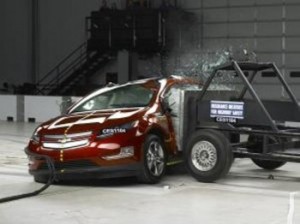
Crash testing of Chevy Volt
General Motors Co. said Monday a "couple dozen" Chevrolet Volt owners have asked the Detroit automaker to repurchase their extended-range electric vehicles in the face of a federal safety investigation into fires after crash-testing.

GM spokesman Greg Martin said the company was talking to owners about their concerns. He reiterated that the company will buy back the vehicles if customers aren't happy. He also emphasized the Volt is safe.

"Our actions will be guided by our customers' satisfaction," Martin said.

The company is working with Volt owners individually to understand their concerns. GM's preference is to give Volt owners loaner vehicles until the National Highway Traffic Safety Administration completes its investigation.

"We continue to find Volt owners by and large some of the most intensely loyal customers in the industry," Martin said.

"For those few who have requested repurchase, we're going to move fast" if their concerns can't be met any other way, he added.

On May 12, NHTSA crash tested a Chevy Volt in a side-collision impact in Wisconsin. The Volt battery caught fire three weeks later. NHTSA said the fire was caused by damage to the vehicle's lithium-ion battery pack and a coolant line that was ruptured.

As a result of that fire, NHTSA conducted tests on three more Volt battery packs last month at a Defense Department facility in Hampton Roads, Va. The tests intentionally damaged the Volts' lithium-ion battery packs and ruptured the vehicle coolant line.

One of those tests sparked a fire seven days after the test on Thanksgiving. Another of the tests resulted in smoke and sparking that lasted less than a second.

GM and NHTSA both say they have no complaints or reports of fires tied to real-world Volts. NHTSA's preliminary investigation could take six months or more.

More than 230 Volt owners, including former Michigan Gov. Jennifer Granholm, have signed an open letter defending the vehicle.

"We are keeping the keys to our Volts. We love our Volts and we feel safe driving our Volts," the owners wrote. "Volt owners feel assured knowing that government and industry are working together to define and communicate this process for electric vehicles, just as they have done for gasoline-powered cars in years past."

_________________
source: Detroit News (Shepardson, 12/5)